
When AI Talks About You, It Checks Your Website First.
Right now, a machine is explaining your company to a potential customer who will never click on one of your ads. It learned most of what it's saying from your website — so it's worth asking how prepared your website is to tell your story.
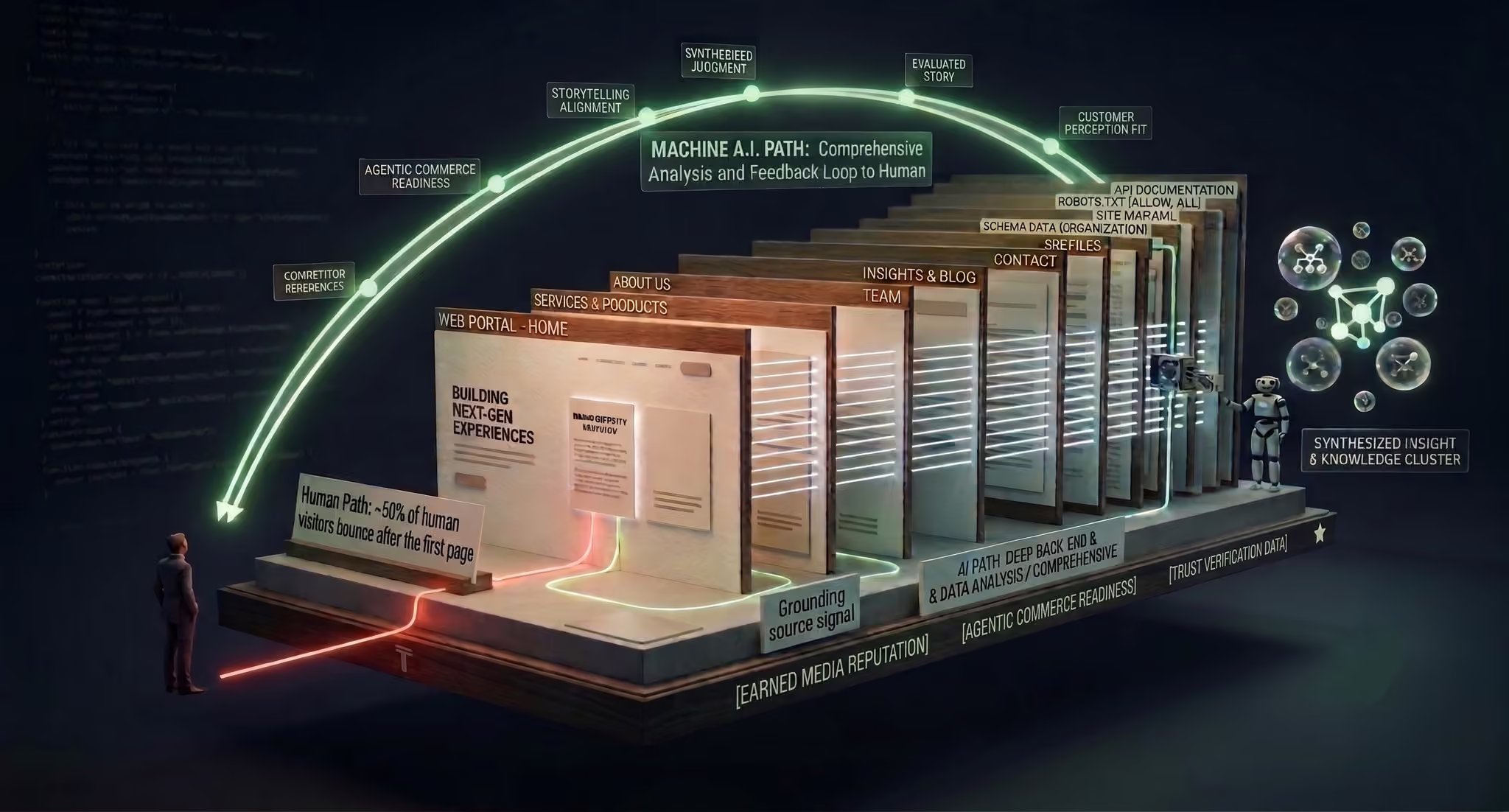
I have spent my entire 20+ year career in the broader digital professional services space, and for the past ten years, a lingering question has persisted among digital leaders and CMOs: "Do we even need a website?" As digital interactions increasingly shifted to mobile and as social commerce, app-based commerce, and loyalty programs proliferated, the lowly website took a back seat.
It's 2026, though, and the rise of large language AI models has flipped that on its head.
In my last piece, I argued that the scariest AI question for most companies isn't "Will it take our jobs?" It's "Will customers even find us?" I ended by promising a follow-up on the one asset that, surprisingly, determines the answer.
It's your website. And it's out there, having conversations about you that you weren't even invited to.
Picture a potential customer somewhere asking Claude or ChatGPT, "Is brand X any good?" with your company's name in the blank. A confident, friendly paragraph appears in the chat window. It makes a judgment about you. Maybe it name-drops a competitor. The customer reads it, nods, and gets on with their day. You will never know it even happened.
So where did that paragraph come from? Partly from what the rest of the world says about you, aka "earned" media. That includes news articles, Reddit threads, review sites, etc. But when a large language model (LLM) needs to get its facts straight — what you do, who you're for, and why anyone should pick you — it does exactly what your best friend does before a blind date. It looks you up. But the first place it looks isn't Google, it's your website.
AI engineers call this: grounding. Before an LLM says anything about your brand or product, it checks itself against a trusted source. That first check is usually your website. If your website provides a clear, current, confident answer, that becomes the story it tells the user. If your website is vague, outdated, or something nobody's touched since the last rebrand, the machine doesn't politely give up. It improvises — pulling from a stray review here, an old news clip there, or a competitor's "why we're better" page. The paragraph still gets written. You just don't get a say in what it says about you.
The critical AI asset you almost threw away
The irony is that the asset you need most in the age of AI is likely the most under-invested part of your digital presence. And the ground just shifted beneath it.
The digital platforms we all relied on to get found over the last 20 years, e.g., Google, Facebook, X, and TikTok, have become walled-off cities that would rather keep their visitors inside than send them to you (unless you pay them handsomely).
The numbers are stark. By early 2026, more than two-thirds of Google searches ended without a single click to any website. This happened even to the best-resourced of teams: HubSpot, long regarded as one of the sharpest SEO operations in software, saw it firsthand. Its CEO publicly said that AI Overviews have cut search traffic by up to 70% and told investors that organic search is declining globally as fewer people click through.
Translation: fewer people are knocking on your door, and the gatekeepers who decide whether to send anyone your way increasingly aren't people at all.
That means the website you've spent years treating as an afterthought turns out to be the most important piece of property your brand owns. Not rented from an algorithm. Not one terms-of-service update away from vanishing. The single place where you, and only you, get to decide how your brand shows up.
Your website now has two kinds of visitors
And it has to keep both of them happy at the same time.
The first visitor is human, and in 2026, they arrive with intent. When an LLM handles all the easy questions up front, the person who clicks through has already done their searching and browsing. Pew found that when an AI summary is right in front of a user, people click an organic search link about 8% of the time, compared with 15% when it isn't. Fewer visitors, but every one of them is closer to a yes when they hit their site than they were at this time last year, or even six months ago. They didn't come to window-shop. They came to make up their minds and then quickly make a purchase. Greet them with a slow, confusing, half-loaded page, and they're gone before your new hero video hits play.
The second visitor isn't a person at all. It's the machine, a Large Language Model responding to user prompts. It reads. It hunts for clear facts, plain answers, and proof that you are who you say you are. Then it decides whether you're even worth mentioning, sometimes within seconds, long before any human sees the result.
Most company websites were built to dazzle the first visitor and completely forget the second. Beautiful to look at, thin on the content that a machine can see and use. That was fine when humans were the only ones reading. It's a large but quiet problem now that a machine is making the decisions before a user ever gets to your site.
The good news: a website can absolutely win over both. It just has to be built with that as the goal.
01 · Citation rate by content type · Meltwater, 2026
The glossy pages get ignored. The useful ones get quoted.
Turns out the machine has taste after all. It skips the marketing fluff and goes straight to pages with real substance — the data, the straight answers, the genuine expertise.
| Content type | Low | High |
|---|---|---|
| Original research & proprietary data | 38% | 65% |
| Data-rich reports | 28% | 55% |
| Standard blog posts | 6% | 15% |
| Product & marketing pages | 3% | 8% |
SOURCE · Meltwater, AI search visibility analysis (2026)
Which are, conveniently, the exact pages most companies never quite get around to building.
"But we rank #1 on Google"
Take a deep breath for this one. Nearly nine out of ten sources AI pulls into its answers don't appear in Google's top results for the same question. All that hard-won SEO equity you've banked doesn't automatically carry over. Ranking at the top of Google and being picked up in an AI answer are two separate jobs, won in two separate fields — and doing well at the first tells you almost nothing about the second.
02 · Where AI gets its answers vs. where Google ranks you · 2026
Being #1 on Google and being in the AI answer are now two different things.
Most of what AI cites never appears in Google's top results for the same query. Different game, different field.
SOURCE · Moz, AI Mode Citations Study (2026)
This isn't your old SEO program wearing a new hat. It's a different game with different rules — which means it needs its own investment, not a hand-me-down from the search budget. A lot of companies are about to find out they've been practicing for the wrong sport.
The machines showed up. Nobody was home.
Let's dig into the two-visitor problem by examining the rise of Agentic Commerce.
In the past year alone, big AI players have built ways for software "agents" to go find and buy things on a person's behalf. Shoppers can program these agents to do specific searches for any type of product based on price, availability, and size. This eliminates the need for human shoppers to check individual shopping sites for the best deal. These agents don't wander your site admiring the photography. They read your data and decide in a blink.
That's if they can actually see your data. Legacy ecommerce platforms keep their inventory and pricing data behind closed doors. It might look like they have that new pellet grill you have been eyeing in stock, but that will change based on model, shipping destination, etc. When one AI company tried to pull products into its chatbot, it had to go rummaging around retailer websites — because the basics, like what's in stock, what it costs, and when it ships, weren't written down anywhere a machine could read. By the time the buy button went live, fewer than thirty of Shopify's millions of merchants were ready to ring up a sale through it. The customers were ready. The retailer websites weren't.
03 · Agentic commerce, Sep 2025 → March 2026
The buyers arrived faster than the businesses did.
AI shopping went from experiment to infrastructure in under a year. The plumbing got built quicker than the stores behind it.
SOURCE · OpenAI · Shopify · Modern Retail · Fast Company, 2025–2026
There's a happy ending hiding in there. When the robot checkout got messy, everyone — shoppers and platforms alike — fell back to the place the customer already trusted: the brand's own store. In fact, Walmart found that shoppers sent to its own site to check out converted about three times better than those buying inside the chatbot. Even in the most sci-fi version of this future, the road still leads home to your own website. Which is exactly why the companies treating their site like a living business, clear and easy for humans and machines alike, are the ones who'll thrive in the age of AI.
What "invest in your website" actually means
None of this turns useful until it becomes a decision about where the money goes. The good news for a CEO: it comes down to three things, and all of them are actionable today.
Say something worth quoting. A machine can only read and repeat what's actually there. The pages that earn you a mention are the ones with a real point of view — content tied straight to your mission and your business goals, not generic product pages repeating basic information or warmed-over category filler that reads like every other competitor's. If your website won't make a clear, confident case for who you are and why you matter, the AI will happily go find someone who will. After all, it's designed to give the user what they want. Not bad news.
Build it so the machines can actually get in. This is the unglamorous plumbing, and it's where a lot of beautiful brand sites fall apart. Pages that load before anyone — human or machine — gives up waiting (engineers care about Core Web Vitals; your customers just want to avoid the spinning wheel of death). A clean structure with clean code that a machine can read. And the digital equivalent of a guest list: small files like robots.txt that quietly tell AI crawlers what they are allowed to see and why. Plenty of companies have accidentally bolted the door on the very machines they most need to let in and have no idea they've done it.
Never stop feeding it. A website isn't a monument you unveil once and admire forever. Machines reward what's alive and current — new products, fresh reviews, recent proof you're busy and worth recommending this week, not in 2021. A site that hasn't meaningfully changed in two years reads, to a machine, like a shop with dust on the shelves and a flickering "open" sign.
Notice what all three have in common: not one of them runs itself. This is the part that the "AI will just handle it" crowd keeps glossing over. The machines are extraordinary at speed and scale, but they need capable people aiming them at the right goals and making the judgment calls a machine simply can't — and they need an organization built deliberately to do that work well, week after week after week. Designers, engineers, product managers, and content creators. The tools are the easy part. The humans and the process behind them are what separate a website that compounds in value from one that quietly rots.
So, quick question: who owns this?
Here's the one to raise at your next leadership meeting, ideally while slowly making eye contact around the table. Who, exactly, owns how your brand shows up inside an AI answer?
Go ahead. Ask your CMO. Then enjoy the silence.
In most companies, the honest answer is "we're, ah, looking into it." The job falls in the cracks between marketing, brand, SEO, digital, and IT — which is a polite way of saying it belongs to no one. So, the website gets a refresh whenever somebody complains loudly enough, while the single most important version of your brand in the entire digital world slowly goes stale.
That's not really a tech problem. It's a nobody-holding-the-wheel problem. The companies pulling ahead didn't outspend everyone. They decided this mattered, put a real person in charge, and started treating their website like the serious asset it became while the rest of us were looking the other way.
The conversation between AI and your brand is already happening
So, here's where we stand. There's a conversation about your company unfolding right now, today, in millions of little chat windows you will never see. Your website is the one voice in that conversation you actually control. Every month you leave it sitting there as an outdated brochure is another month the machines fill in the blanks for you — and they will not be shy about it.
The hopeful part: this is fixable. And the companies that move first get to decide how they're understood before their competitors even notice the conversation began.
That's the work we do at Thresh. Strategy, design, and engineering in one room, turning a website back into a business platform — built for the people you want to win and the machines now deciding whether those people ever hear your name. If you just pictured your own site and felt a small knot in your stomach, trust it. Let's talk before the machines finish writing your story without you.
Sources
- Less than one third of Google searches still send a click (68% zero-click, early 2026)
SparkToro / Similarweb clickstream analysis (June 2026)
- HubSpot's CEO: Google's AI Overviews have cut search traffic by as much as 70%
Yamini Rangan, HubSpot CEO, public remarks (2025)
- Users click a traditional result 8% of the time when an AI summary is present, vs. 15% without
Pew Research Center, behavioral study of 68,879 searches (July 22, 2025)
- AI citation rate by content type (original research 38–65%; data-rich reports 28–55%; standard blog 6–15%; marketing 3–8%)
Meltwater, AI search visibility analysis (2026)
- 88% of Google AI Mode citations are not in the organic top 10 for the same query
Moz, AI Mode Citations Study (2026)
- ChatGPT Instant Checkout and the Agentic Commerce Protocol
OpenAI (2025–2026)
- Millions of merchants can sell in AI chats via Agentic Storefronts
Shopify (2026)
- OpenAI scales back Instant Checkout; fewer than 30 merchants went live
Fast Company (May 2026); Modern Retail (April 2026)
- Walmart's ChatGPT checkout converted about one-third as well as its own site
Daniel Danker, Walmart EVP, reported by WIRED and Search Engine Land (March 2026)

Next insights
Keep reading.
STRATEGY ·
AI Isn't Just Replacing Your Workforce. It's Replacing Your Brand.
9 min read